Recent Progress in Cancer Nanotheranostics: Multifunctional Platforms for Precision Oncology
Keywords:
- Nanotheranostics, multi-organ cancer, precision oncology, imaging-guided therapy, targeted drug delivery, clinical translation
Abstract
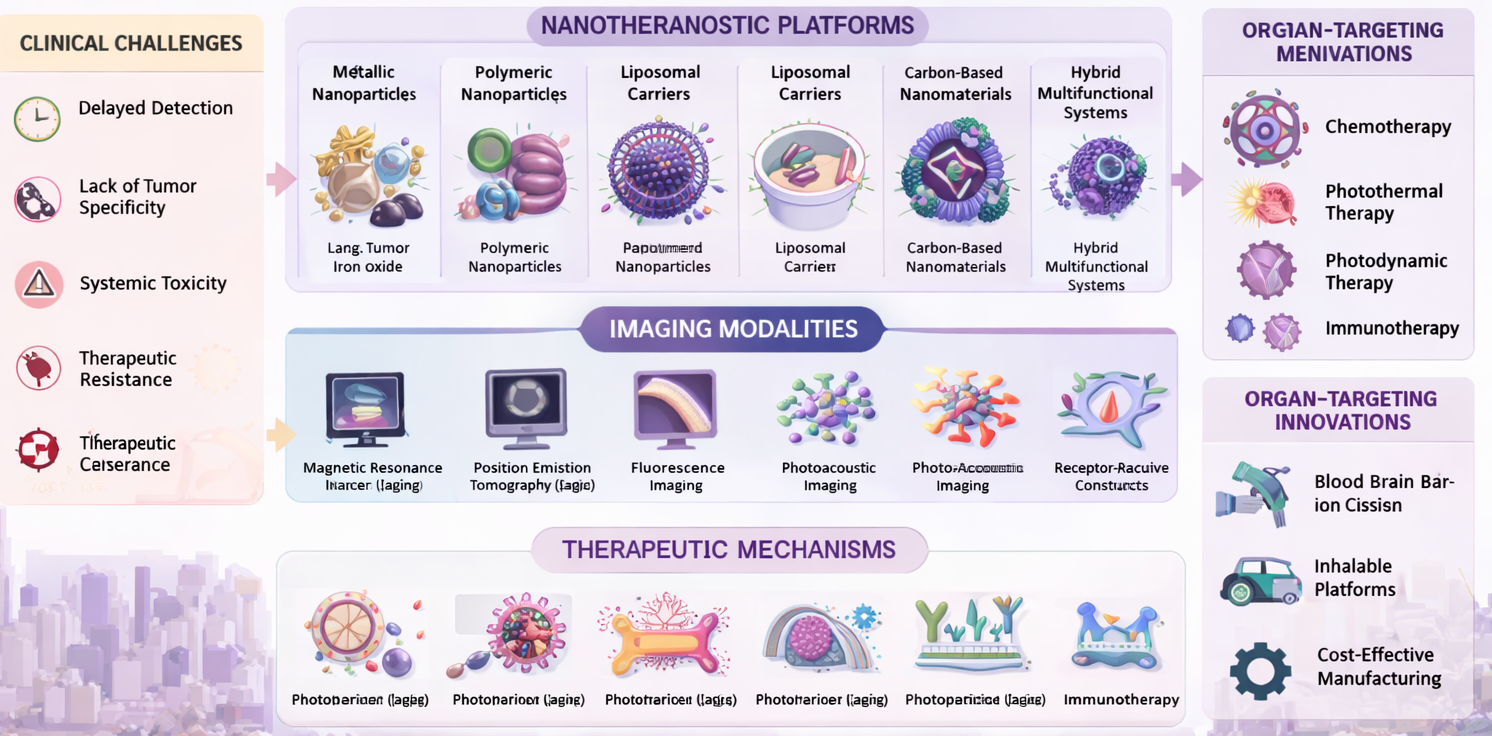
Its value as a health burden is still important because cancer has been one of the leading causes in the world, where liver, lung, pancreatic, breast and brain cancers make up copious mortality and fatalities. Conventional diagnostic and therapeutic modalities are frequently faced with delayed detection, insufficient tumor specificity, systemic toxicity, and the development of therapeutic resistance, emphasizing an imperative to develop integrated and selective strategies. Consistent with the above-mentioned definition, this systematic review summarizes advances from 2020 to 2025 in almost five main types of nanotheranostics (i.e., nanostructures for simultaneous diagnosis and therapy) in cancer biology. Methods. A systematic literature search with PubMed, Scopus and Web of Science was conducted to identify any studies assessing the relationship between COVID-19 risk factors defined as a history of or concurrent chronic disease and COVID-19 infection or COVID-19-related mortality from January 2020 to June 2025. Inclusion Criteria: Eligible studies were defined as those reporting on nanoplatforms having both diagnostic imaging and therapeutic function in liver, lung, pancreatic, breast or brain tumors; Data extracted included nanomaterial composition, imaging modality, therapeutic mechanism and experimental outcomes, as well as physical indicators of translational feasibility. Results illustrate major advancements in metallic nanoparticles, polymeric and liposomal carriers, carbon-based nanomaterials and hybrid multifunctional systems that improve imaging sensitivity via different modalities including magnetic resonance imaging (MRI), positron emission tomography (PET), fluorescence and photoacoustic imaging while providing targeted therapeutic delivery through chemotherapy, photothermal therapy, photodynamic therapy and immunotherapy. Organ-targeting innovations such as blood-brain barrier–permeable carriers, inhalable nano-platforms, stroma-modulating systems and receptor-targeted constructs add to this precision. While preclinical and early clinical results have been promising, safety validation, regulatory approval, manufacture at scale and cost-effectiveness for healthcare delivery continue to pose challenges. Interdisciplinary collaboration and ongoing refinement of the technology are likely to foster clinical translation, paving the way toward global precision oncology.