Sustainable Solid Dispersion Approach Using Tamarind Seed Mucilage for Enhanced Drug Release
Keywords:
- Ibuprofen; Solid dispersion; Co-solvency method; Tamarind seed mucilage; Natural polymer; Solubility enhancement; Bioavailability; Amorphous drug form; Solvent evaporation; Drug–polymer ratio; In vitro dissolution.
Abstract
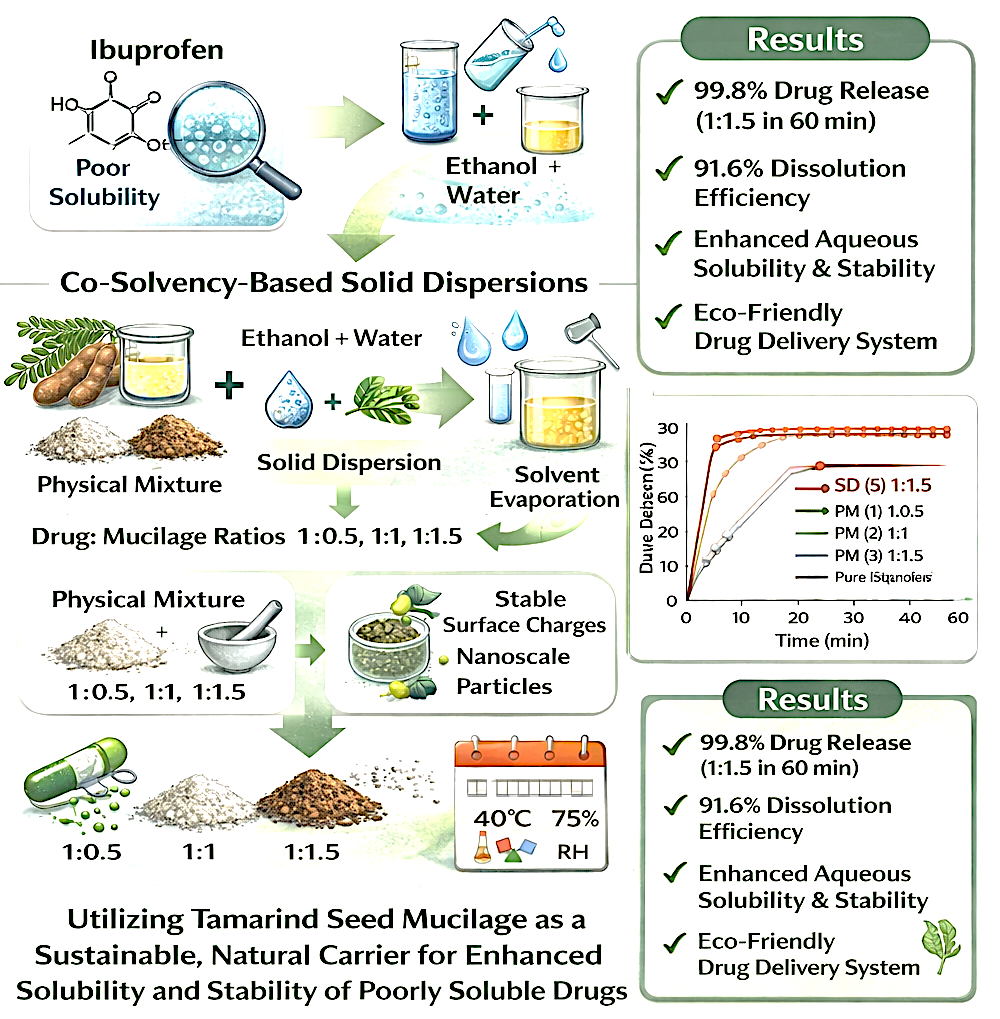
Ibuprofen is difficult to dissolve in water and has limited bioavailability. To enhance dissolution and stability, the study explores a co-solvency-based solid dispersion method using tamarind seed mucilage as a natural polymer carrier. Drug: mucilage ratios of 1:0.5, 1:1, and 1:1.5 were employed, with ethanol as a co-solvent under a solvent evaporation method. Equivalent physical mixtures were prepared for comparison. Along with FTIR and XRD studies endorsing ibuprofen's change to amorphous nature without chemical interaction with the carrier, phytochemical tests established the presence of bioactive chemicals in the mucilage.
Substantial progress was demonstrated in in vitro dissolution testing; the SD (3) 1:1.5 formulation had a dissolution efficiency of 91.6% and 99.8% drug release within 60 minutes. Particle size and zeta potential measurements indicated stable surface charges and nanoscale particles, particularly for SD (3). Compared to physical blends and pure ibuprofen, solid dispersions showed improved drug content and release effectiveness throughout the semiannual stability test under 40°C, 75% relative humidity. These results illustrate how tamarind seed mucilage can be utilized in co-solvency-based solid dispersions as an effective and environmentally friendly means of increasing solubility and therapeutic effectiveness of drugs with low aqueous solubility.
This approach paves the way for improved drug delivery systems through offering a sustainable, scalable alternative and encouraging more research into natural carriers for drug formulations.